

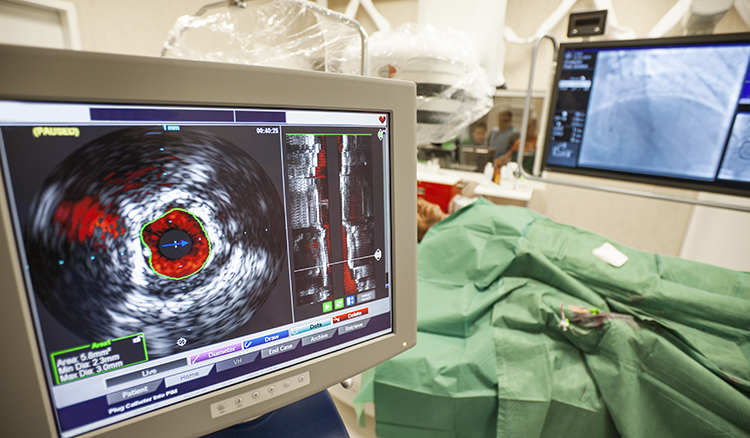
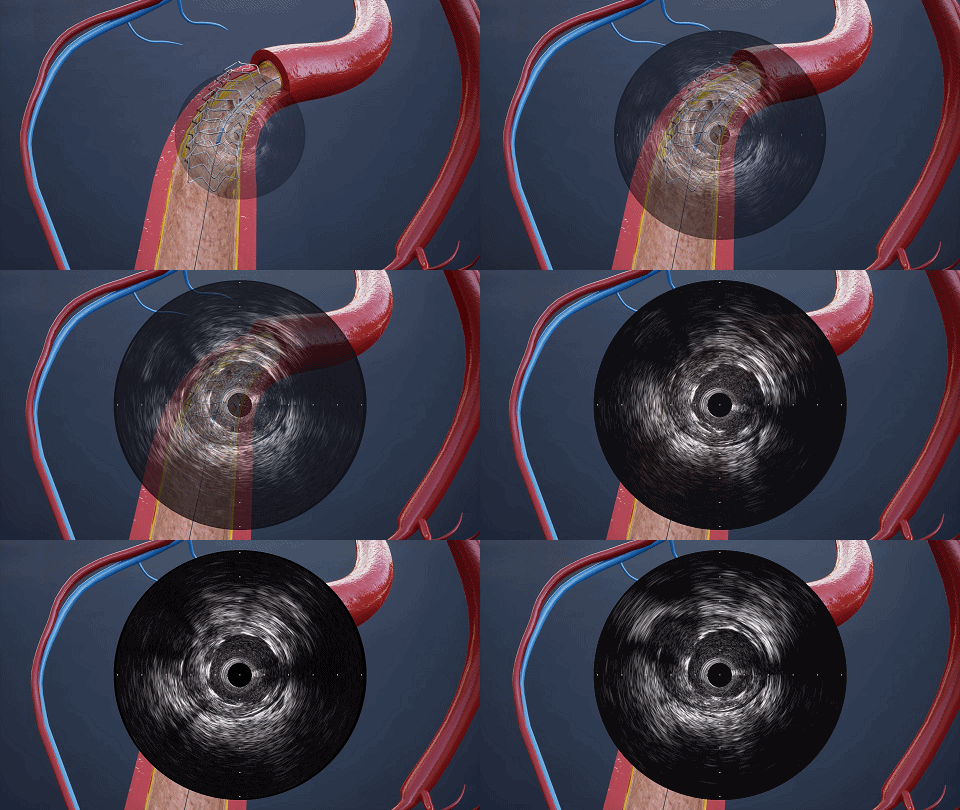
Intravascular Ultrasound(IVUS) systems are medical devices that visaualize inner-vessel imagery.They are widely used in the diagnosis and treatment of coronary heart disease,myocardial infarction and vascular stenosis.
Nevertheless,IVUS systems face significant hardware-level challenges.First high-performance computing is required to process masssive image datasets at high speed.Second,deployed in clinical settings for prolonged continuous operation,the systems must deliver high stability and reliability,Third,high-quality image rendering capability is essential to deliver accurate patient data for clinicias.
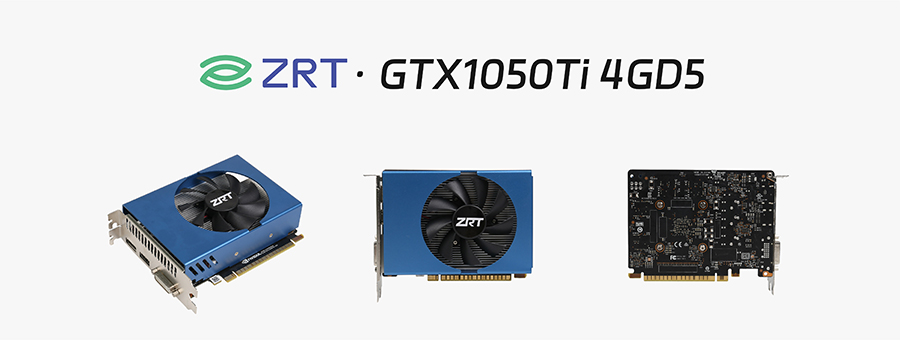
To address the above technical challenges,a medical device enterprise has integrated ZRT’s GTX1050Ti 4GD5 PCle graphics card into its IVUS system.Serving as the core for image processing and display,the ZRT graphics card delivers robust computing power and high-fidelity image output,which effectively upgrades the overall system performance of IVUS medical equipment.
Equipped with ZRT’s GTX1050Ti 4GD5 PCle graphics card, the IVUS system leverages the card’s powerful computing capacity and efficient graphics processing to rapidly process large-volume image data and generate high-resolution interavascular images.It also delivers real-time visualization of vascular structures,enabling clinicians to assess patient conditions promplty.
Meanwhile, the graphics card features outstanding stability and reliability for long-duration continuous operation,ensuring consistent IVUS system performance.Furthermore,it supports user-friendly UI and interactive functions,allowing physicians to operate the device and review imaging data with greater ease.
The ZRT NVIDIA GeForce GTX1050Ti 4GD5 graphics card is built around the NVIDIA GeForce GTX1050Ti GPU,feating 768 CUDA cores.It comes with 4GB GDDR5 video memory,a 128-bit memory bus,and a core clock ranging from 1354MHz to 1468 MHz.Display outputs include DP, HDMI and DVI interfaces.
Accordingly,adoption of the GTX1050Ti 4GD5 card delivers notable improvements in image quality and real-time perfoemance for the IVUS system.In clinical practice,this helps clinicians identify and evaluate lesions such as vascular stenosis and plaques with higher accuracy,formulate more targeted treatment plans,and improve therapeutic outcomes.
