
Case Overview
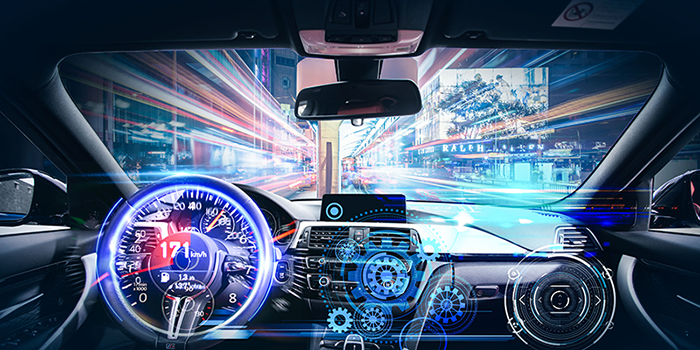
In real-world deployment of autonomous driving systems, hardware serves as the core foundation for fast and accurate data and image processing. With the rapid advancement of autonomous driving technologies, market requirements for hardware performance continue to escalate. High-level autonomous driving systems require powerful computing and graphics rendering capabilities to support swift and reliable driving decision-making. Meanwhile, the expanding application scenarios of autonomous driving have raised higher standards for equipment portability and thermal performance.
Objectives and Challenges
As one of the core hardware components within autonomous driving systems, the GPU undertakes the system’s image processing and rendering tasks. GPU performance directly determines the real‑time capability, accuracy and stability of autonomous driving systems. Accordingly, high‑end autonomous driving systems impose the following requirements on GPUs:
1.Autonomous driving systems must process massive volumes of sensor data and image information in real‑time, requiring GPUs with robust computing power and high throughput to satisfy system real‑time performance requirements.
2.Graphics Rendering Accuracy: To enable reliable driving decisions, the GPU must deliver high‑precision graphics rendering and ensure accurate, real‑time image processing.
3.Stability and Reliability: Autonomous driving systems require failure-free operation, imposing stringent standards for GPU stability and reliability to adapt to diverse and complex operating environments.
4.Compactness and Thermal Performance: With increasingly integrated autonomous driving systems, GPUs are required to feature compact dimensions and superior thermal performance to meet system demands for high compactness and long-term durability.
5.Cost Efficiency and Scalability: Customers seek to minimize GPU deployment costs while sustaining stable performance and reliability. The GPU must deliver excellent scalability to accommodate future technological upgrades and functional expansion.

ZRT Solution Advantages
To address the above challenges, ZRT Technology provides high-performance MXM GPUs for the customer’s autonomous driving systems:MM3080TIB6-16G .This GPU adopts the NVIDIA GeForce RTX3080Ti Mobility chip, equipped with 16GB 256-bit GDDR6 large-capacity video memory. It features 7424 stream processors and delivers robust single-precision floating-point performance of 19954 GFLOPS. In addition, the GPU complies with the Type B form factor (105×82 mm) and is fitted with 4 DP display interfaces.
Boasting robust computing power and high throughput, the MM3080TIB6-16G GPU fully satisfies the high-performance computing demands of autonomous driving systems. Its large-capacity VRAM delivers ample memory support for sophisticated graphics rendering, enabling the system to process massive image datasets and high-resolution textures efficiently. Equipped with four DisplayPort interfaces, the GPU supports multi-screen interaction and high-definition video output. Featuring a standard Type B form factor, it enables seamless integration with embedded systems of diverse specifications. Furthermore, it adopts an optimized thermal design with low power consumption and outstanding energy efficiency. Superior integration compatibility and scalability provide reliable guarantees for the long-term stable operation of autonomous driving systems.

Delivering robust computing power, high stability and superior thermal performance, theMM3080TIB6-16GGPU significantly improves autonomous driving systems in data processing speed, operational stability and device compactness. It effectively enhances system reliability across diverse operating conditions, supports timely and precise driving decision-making, and improves overall driving safety and comfort. Empowered by ZRT’s high-compute MXM GPU series, the solution fuels the innovation of autonomous driving technology, delivers stronger computing support for vehicle systems, and accelerates the arrival of a new era of safer, smarter and more convenient mobility.